KEY TAKEAWAYS
- Big Deck Companies vs Small Local Builders comes down to scale versus personal accountability.
- Large deck installation companies often have financing options and bigger crews for faster completion.
- Local deck builders usually give you direct access to the owner throughout the project.
- Always confirm Pennsylvania contractor registration and insurance before signing any contract.
- Custom, complex, or sloped-lot decks often benefit from a specialist small builder’s experience.
- A written contract with clear payment milestones protects you with either type of contractor.
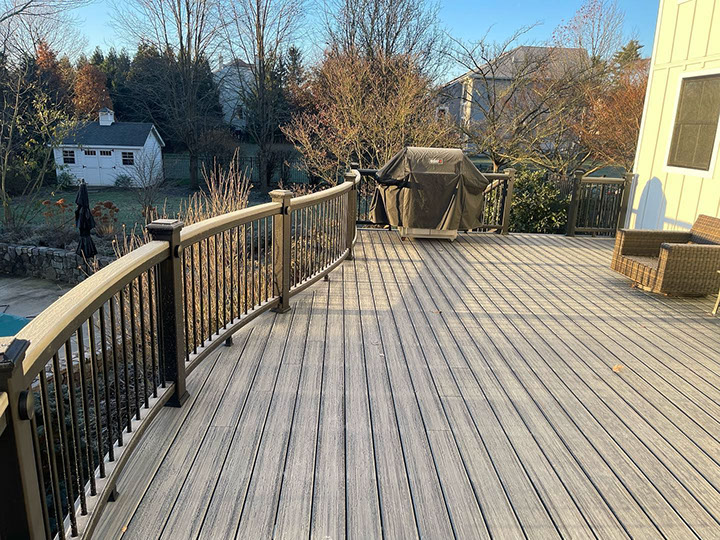
A new deck is one of the biggest outdoor investments most homeowners make, and the contractor you choose matters as much as the materials. When you compare Big Deck Companies vs Small Local Builders, you are really choosing between two different ways of working: a structured, high-volume operation or a hands-on, owner-led crew.
Neither option is automatically better. In this guide, you will learn how each type of deck contractor handles pricing, design, scheduling, warranties, and communication. You will also get a step-by-step hiring process, a comparison table, and the red flags to watch for before you sign anything.
If you live in Bucks County or anywhere in Pennsylvania, you will also find local considerations like contractor registration and permit rules that apply to every deck build.
What Counts as a “Big Deck Company” vs a “Small Local Builder”?
Big Deck Companies
Big deck companies are usually regional or multi-location deck construction companies. Some are franchises. They tend to have sales teams, project managers, office staff, and multiple installation crews running at once.
You often meet a salesperson first, then a designer, then a crew lead. The owner may never visit your property.
Small Local Builders
Small local deck builders are typically owner-operated businesses with one or two crews. The person who quotes your job is often the same person who swings a hammer on it or supervises it daily.
They usually work within a tighter service area, such as a single county or a handful of nearby towns. Their reputation travels mostly by word of mouth, reviews, and repeat neighbors.
Big Deck Companies vs Small Local Builders: Side-by-Side Comparison
| Factor | Big Deck Companies | Small Local Builders |
|---|---|---|
| Point of contact | Salesperson, then project manager | Usually the owner directly |
| Pricing | Often higher due to overhead and sales costs | Often more flexible, varies widely |
| Financing | Commonly offered through lending partners | Less common, sometimes available |
| Scheduling | More crews, may start sooner in busy seasons | Can book out months in peak season |
| Design flexibility | Often package-based or standard designs | Usually more open to custom work |
| Crew consistency | Crews may rotate or be subcontracted | Same small crew from start to finish |
| Warranty | Often formal, written, company-backed | Varies, depends on the builder’s policy |
| Local code knowledge | Varies by branch and crew | Usually strong in their home area |
| Accountability | Corporate process, escalation paths | Personal reputation on the line |
Pros vs. Cons of Each Option
Big Deck Companies
Pros:
- Structured processes, from estimate to final inspection
- Financing programs that spread the cost over time
- Multiple crews, which can mean shorter wait times
- Formal written warranties backed by a larger business
- Established supplier relationships for materials
Cons:
- Higher overhead can push prices up
- You may deal with several people instead of one
- Some installation work may be handled by subcontractors
- Less flexibility for unusual or highly custom designs
- Sales pressure, such as “today only” pricing, is more common
Small Local Builders
Pros:
- Direct communication with the person responsible for quality
- More willingness to handle custom shapes, multi-level decks, and tricky lots
- Strong familiarity with local township permit offices and inspectors
- Reputation-driven work, since every job affects word of mouth
- Pricing that can be more negotiable on scope and materials
Cons:
- Longer wait times during spring and summer
- Fewer financing options
- Warranty terms may be less formal, so you need them in writing
- A single illness or crew issue can delay your project
- Quality varies more widely from one builder to the next
When to Choose Which: Conditional Reasoning
The smartest way to decide is to match the contractor type to your actual project.
- If you need financing and a standard rectangular deck on a flat yard, a larger deck installation company is often a good fit. Their packaged designs and lending partners make that kind of project straightforward.
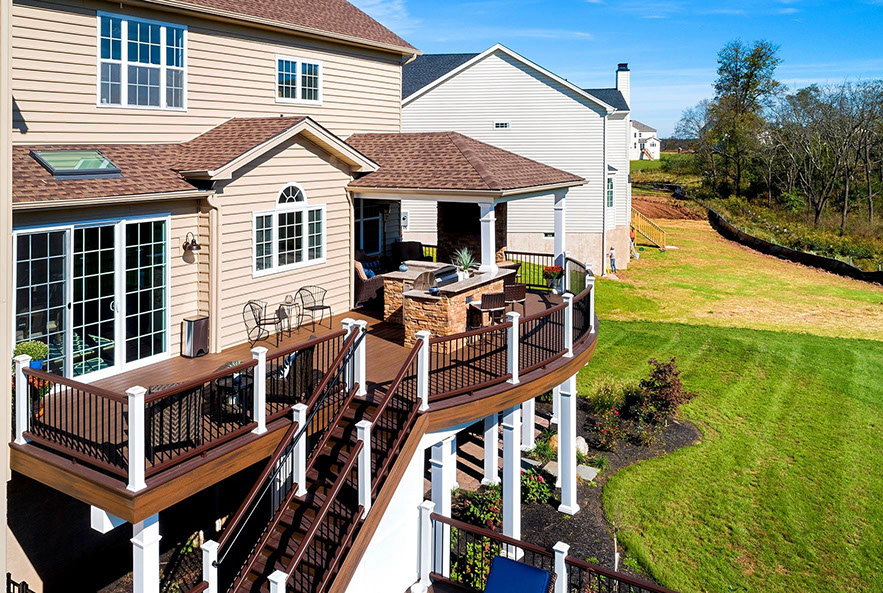
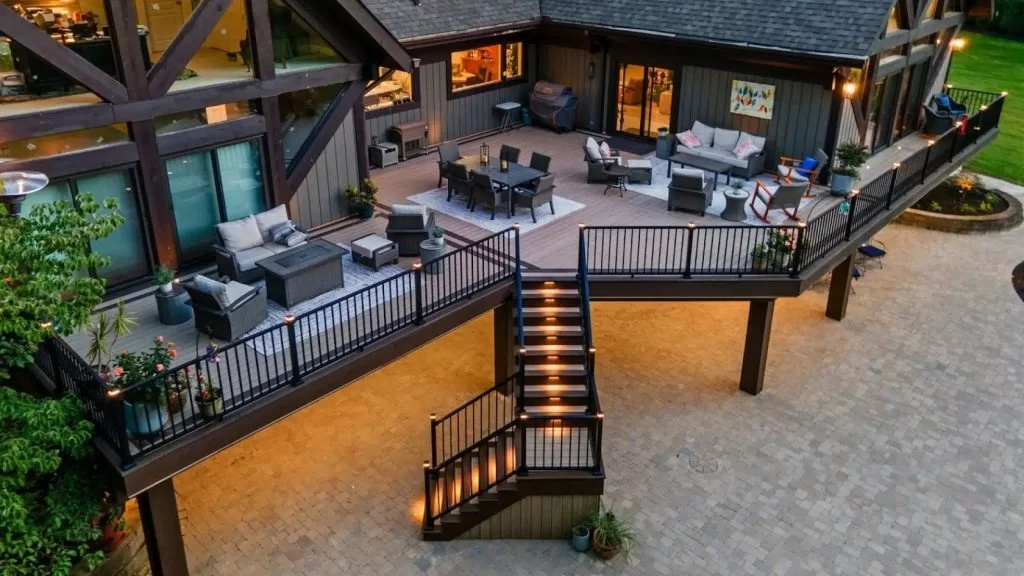
- If your project involves a sloped lot, multiple levels, built-in lighting, or a custom railing design, a small specialist builder is usually the stronger choice. Custom work rewards experience and close supervision.
- If you want the project done before a specific event and local builders are booked solid, a bigger company with more crews may be your only realistic option.
- If you value one consistent point of contact and want to ask questions without going through a call center, a local builder will likely feel better.
How to Hire the Right Deck Contractor: Step by Step
Whether you choose a large company or a small team, use the same vetting process.
- Define your project. Decide on approximate size, material (pressure-treated wood, composite, or PVC), budget range, and must-have features before calling anyone.
- Shortlist three contractors. Search “deck contractors near me,” check Google reviews, and ask neighbors who recently built decks.
- Verify registration. In Pennsylvania, most home improvement contractors must register with the Office of Attorney General under the Home Improvement Consumer Protection Act. Ask for the registration number and confirm it.
- Confirm insurance. Request a certificate of liability insurance and proof of workers’ compensation coverage, sent directly from the insurer if possible.
- Ask about permits. Pennsylvania follows the Uniform Construction Code, and most decks require a building permit from your township. A licensed deck contractor should handle this or explain clearly who will.
- Compare written estimates. Make sure each estimate lists materials, dimensions, footings, railing type, and cleanup so you are comparing the same scope.
- Review past work. Ask for photos of completed projects similar to yours and, if possible, a few recent references.
- Get everything in a written contract. Include start and completion dates, payment milestones, warranty terms, and change-order procedures.
Do / Don’t List for Hiring Deck Builders
Do:
- Get at least three written quotes
- Ask who will actually build your deck (in-house crew or subcontractors)
- Confirm the contractor pulls permits and schedules inspections
- Ask what the warranty covers, for how long, and who honors it
- Read reviews that mention communication, not just finished photos
Don’t:
- Pay a large deposit before materials are ordered or work is scheduled
- Sign on the same day because of a “limited-time” discount
- Accept a verbal warranty
- Hire anyone who suggests skipping the permit to save money
- Choose based on price alone
Red Flags to Watch For
Red flags look the same whether you are talking to a large firm or a one-truck operation. Walk away or slow down if you see any of these:
- No Pennsylvania home improvement contractor registration number on the contract
- Pressure to pay mostly upfront, or in cash only
- Vague estimates without measurements or material specs
- No physical business address or only a cell number
- Reluctance to provide proof of insurance
- Reviews that repeatedly mention missed deadlines, unreturned calls, or unfinished work
The Federal Trade Commission and the Better Business Bureau both publish consumer guidance on hiring home improvement contractors, and both stress getting written contracts and checking credentials before any money changes hands.
Quality and Safety: What Really Matters
The size of the company does not determine whether your deck is safe. Construction details do.
The American Wood Council publishes DCA 6, a widely used prescriptive guide for residential wood deck construction. It covers ledger attachment, footing sizes, guard posts, and connectors. A competent builder, large or small, should be comfortable discussing these deck safety features in plain language.
The North American Deck and Railing Association (NADRA) also promotes regular deck safety checks and good building practices. Ask any contractor how they attach the ledger to your house and how they flash it against water. Their answer tells you a lot about their experience.
Real-World Scenario
A homeowner in central Bucks County wanted a two-level composite deck on a sloped backyard with stairs down to a patio. She got three quotes.
A large regional company offered a fast start date and financing, but its designer suggested a standard single-level layout because the multi-level plan fell outside their usual packages. A small local builder quoted slightly higher on labor but walked the slope with her, recommended adjusted footing depths for the grade, and handled the township permit himself.
She chose the local builder. The project took longer to start, but she communicated with the same person from estimate to final inspection. For a simpler, flat-yard deck, the larger company’s speed and financing might have been the better call.
Quick Answers:
Are big deck companies more expensive than local deck builders?
A: Often, yes. Larger companies carry more overhead for sales staff and offices, which can raise prices, but quotes vary widely, so always compare at least three.
Are small deck builders less reliable?
A: Not necessarily. Reliability depends on the individual contractor’s registration, insurance, reviews, and written contract terms, not company size.
Do I need a permit for a deck in Pennsylvania?
A: Most decks in Pennsylvania require a building permit under the Uniform Construction Code. Check with your township, since requirements can vary by municipality.
How do I verify a deck contractor in Pennsylvania?
A: Ask for their Home Improvement Contractor registration number and confirm it through the Pennsylvania Office of Attorney General. Also request proof of liability insurance.
Which is better for a custom deck design?
A: Small local builders are usually more flexible with custom shapes, multi-level layouts, and difficult lots. Some larger companies also do custom work, so ask to see examples.
Do big deck companies use subcontractors?
A: Some do. Ask directly who will build your deck and whether those crews are employees or subcontractors.
What should a deck contract include?
A: It should include scope, materials, dimensions, total price, payment schedule, start and completion dates, warranty terms, and the contractor’s registration number.
How much deposit should I pay a deck builder?
A: Keep deposits modest and tied to clear milestones such as material delivery. Avoid paying most of the total before work begins.
Glossary of Terms
Ledger board: The board that attaches a deck to the house. A poorly attached or unflashed ledger is a common cause of deck failure.
Footing: The concrete base set into the ground that supports deck posts. Footing depth must account for local frost lines.
Change order: A written agreement that modifies the original contract scope, price, or schedule after work begins.
Home Improvement Contractor registration: A Pennsylvania requirement under which most contractors doing home improvement work must register with the Office of Attorney General.

Conclusion
Comparing Big Deck Companies vs Small Local Builders is less about which is “better” and more about which fits your project. Larger deck installation companies shine with financing, structured processes, and faster starts. Small local builders shine with custom designs, direct owner communication, and close knowledge of local permits and inspectors.
Whichever route you take, protect yourself the same way: verify Pennsylvania registration, confirm insurance, get three written quotes, and never sign without a detailed contract.
Ready to plan your new deck? Talk to Bucks Mont Decks, a registered and insured deck builder serving Bucks County. Request your free on-site estimate today and get straight answers from the person who will actually build your deck.