Key Takeaways
- The best Lehigh Valley deck contractors carry state registration, insurance, and local permit experience.
- Pennsylvania requires most home improvement contractors to register with the Attorney General’s office.
- Ask for a certificate of insurance sent directly from the insurance carrier, not the contractor.
- Contracts should name decking brand, series, color, and fastener type, not just “composite.”
- Deposits above roughly one third of the project total are a common warning sign.
- Walking a finished deck in person tells you more than any gallery page will.
Why Choosing the Right Builder Matters More Than the Deck Itself
A deck is one of the few home projects where the quality of the crew is more important than the quality of the material. Premium boards installed over undersized framing will still sag. Budget lumber installed correctly, flashed properly, and permitted on time will outlast it.
That is the real reason homeowners across Allentown, Bethlehem, and Easton spend so much time comparing Lehigh Valley deck contractors before they ever pick a color. The decision you are actually making is about structural work you will never see again once the boards go down.
This guide walks through what to verify, what to compare, and what should end a conversation early. By the end you will have a repeatable process for evaluating any local deck builders you contact, whether you found them through a neighbor, a truck in the driveway, or a search for deck contractors near me.
What “Local” Actually Means Here
The Lehigh Valley covers Lehigh and Northampton counties, with Allentown, Bethlehem, and Easton at the center and townships like Whitehall, Emmaus, Nazareth, and Upper Saucon surrounding them. Each municipality runs its own permitting and inspection process.
That fragmentation is why local experience carries real weight. A builder who has pulled twenty permits in Bethlehem Township knows the plan submission format, the inspection sequence, and the typical turnaround. A crew coming in from two hours away is learning it on your project, on your timeline.
Freeze and thaw cycles matter too. Footings in this region need to reach below the local frost line, and inspectors check it. Contractors who work here year after year size and set footings without being told twice.
If you live near the Bucks County line and are weighing companies from both sides, extend the same test in both directions. Someone billed as one of the best deck builders Bucks County offers may still be a first timer at your township’s permit desk.
Credentials That Are Not Optional in Pennsylvania
Pennsylvania does not issue a trade license specifically for deck building. It does something arguably more useful for consumers: it requires most home improvement contractors above a modest annual work threshold to register with the Pennsylvania Attorney General’s office, and that registry is publicly searchable. Registration numbers are supposed to appear on contracts and advertising.
That registry is your first filter. Any list of licensed deck contractors you assemble should start there. Before relying on a number provided verbally, take a moment to verify a contractor’s state registration yourself. You can also search the state’s contractor registry directly to confirm active status.
Insurance is the second filter, and it is where most homeowners get careless. Ask for general liability and workers’ compensation coverage, and insist on a certificate of insurance sent directly from the insurer, not a PDF forwarded by the contractor. Policies lapse. Certificates get edited. Going to the source takes one email.
Third, ask who is pulling the permit. If the answer is “you can pull it as the homeowner, it is faster,” treat that as a decision the contractor made for their benefit, not yours. Homeowner-pulled permits shift liability for code compliance onto you. Get the permit question answered in writing before any deposit changes hands.
For code context, the International Code Council publishes the residential provisions that Pennsylvania municipalities build their requirements from, and the American Wood Council publishes widely used prescriptive guidance for residential wood deck construction. We recommend you download the industry-standard deck construction guide (DCA 6) as a reference. The North American Deck and Railing Association is a useful reference point for industry practice and contractor accreditation; you can browse NADRA’s member directory and credentials to find vetted professionals.
How to Vet Deck Installation Companies: A 7-Step Process
- Search the state registry. Confirm the business name and registration status match what appears on their proposal and website.
- Verify insurance at the source. Request certificates for general liability and workers’ compensation directly from the carrier or agent.
- Ask for three recent local addresses. Not photos, addresses. Recent means the last twelve to eighteen months.
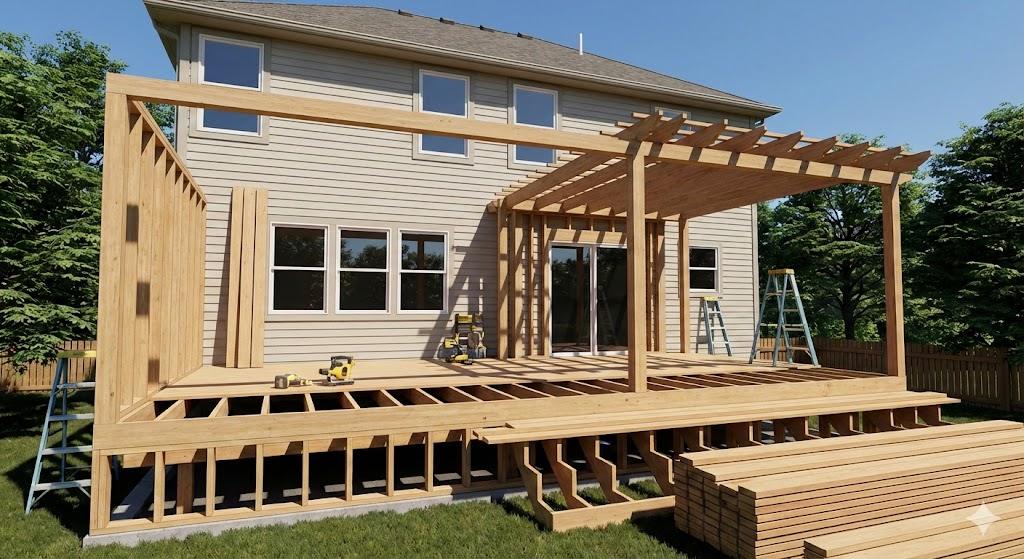
- Walk one finished deck. Look under it. Check joist hangers, ledger flashing, post connections, and whether the framing is straight.
- Collect three itemized bids. Each should break out demolition, footings, framing, decking, railing, permits, and disposal as separate lines.
- Compare the contracts, not the totals. Payment schedule, change order process, warranty terms, and material specifications are where bids actually differ.
- Check the complaint record. The Better Business Bureau and your county consumer protection office both keep records worth two minutes of your time.
Run this on every candidate. Two of your three bidders will usually eliminate themselves at step one or step two.
Comparing Your Options
Not every project needs the same type of company. Here is how the common choices compare for a typical residential build. If you are unsure which category fits your needs, learn how to choose the right type of builder for your project.
| Factor | Deck Specialist | General Contractor | Handyman or Solo Carpenter |
|---|---|---|---|
| Typical price | Middle to high | Highest | Lowest |
| Permit handling | Routine, done in house | Routine, sometimes subcontracted | Often pushed to homeowner |
| Crew experience with decks | Daily | Occasional | Varies widely |
| Insurance depth | General liability plus workers’ comp standard | Comprehensive | Frequently minimal or absent |
| Structural warranty | Commonly two to five years on workmanship | Varies by contract | Rarely written |
| Best fit | Standalone deck builds and rebuilds | Deck as part of a larger renovation | Small repairs, board swaps, railing fixes |
If your project is a standalone deck or a full tear off and rebuild, choose a specialist. They will be faster, they price the work more accurately, and their crews are not splitting attention between your deck and a kitchen remodel.
If the deck is one piece of a larger addition or hardscape project, choose a general contractor and let them coordinate the trades. Fragmenting a large job across separate deck building services near me searches usually costs more in scheduling gaps than you save on the line item.
Material Choices and How They Shape Your Search
Your material decision narrows your contractor list, because installation systems differ. To make an informed choice, compare composite and wood decking options before requesting bids.
Composite and PVC Decking
- Pros: Minimal maintenance, no annual staining, long manufacturer warranties, stable color, hidden fastener systems available.
- Cons: Higher material cost, surface heats up more in direct sun, cannot be sanded or refinished, and requires tighter joist spacing on many product lines.
Pressure Treated Wood
- Pros: Lowest upfront cost, easy to source locally, simple to repair board by board, familiar to every crew.
- Cons: Annual or biannual cleaning and sealing, prone to checking and warping, shorter service life, fasteners can corrode without proper coating.
If you choose a composite or PVC product, ask whether the crew holds the manufacturer’s installer credential. Several major brands offer extended labor coverage only when a credentialed installer does the work. That single question can be worth thousands over the life of the deck.
Red Flags That Should End the Conversation
While this list covers the most critical warnings, we encourage you to watch for these additional warning signs during your vetting process.
- Door to door solicitation after a storm. Legitimate deck construction companies Pennsylvania homeowners rely on do not build their books this way.
- No written contract, or a one page contract with no material specifications.
- A deposit demand of half or more up front. Materials do not require that much cash before delivery, and you should never pay the full balance up front.
- Cash only pricing, or a discount for paying outside normal channels.
- No physical business address, and a phone number that goes only to voicemail.
- Pressure tactics tied to a same day signature. Real pricing is good for at least a week.
- Refusal to provide a registration number. In Pennsylvania this is not a small omission.
- Vague material language. “Composite decking” is not a specification. Insist on a contract that lists materials by brand, series, and color.
Do and Don’t
Do
- Do get three bids, and do read all three contracts end to end.
- Do confirm who supervises the crew daily and how you reach them.
- Do photograph footings and framing before the decking goes down.
- Do keep the permit and final inspection paperwork with your home records.
- Do walk at least one finished deck in person.
Don’t
- Don’t choose on price alone. The lowest bid is often the most expensive deck once change orders land.
- Don’t accept verbal change orders. Everything in writing, signed, with a price.
- Don’t allow work to start before the permit is issued.
- Don’t pay the final installment before the final inspection passes.
- Don’t skip reading the warranty exclusions. That is where the real terms live.
A Real-World Scenario
A homeowner in Emmaus replacing a twenty year old pressure treated deck. She collects three bids: one noticeably low, one middle, one high.
The low bid is a two page document with no registration number and no material brand listed. The middle bid names the decking product by series and color, itemizes footings and permits separately, and sets a payment schedule of a modest deposit, a draw at framing inspection, and the balance at final inspection. The high bid is from a general contractor also proposing a patio and pergola she did not ask for.
She calls the middle bidder’s two most recent local customers, visits one deck, and looks underneath. The joist hangers are fully nailed, the ledger is flashed, and the framing is level. She hires them.
During demolition the crew finds rot in the rim joist where the old ledger was attached. Because the contract defined a change order process with unit pricing, the repair is documented and priced the same day rather than becoming a dispute. The project finishes on schedule.
Nothing about that outcome was luck. It was the contract.
Quick Answers:
Do I need a permit to build a deck in the Lehigh Valley?
A: In most municipalities, yes. Attached decks and any deck above a certain height almost always require a permit and inspections. Confirm with your township or borough code office, or understand the local permit process before starting.
Are deck contractors licensed in Pennsylvania?
A: There is no state deck-specific trade license, but most home improvement contractors must register with the Pennsylvania Attorney General’s office. Some municipalities add their own local requirements.
How long does a deck build take?
A: Most straightforward residential builds run one to three weeks of active work. Permit review, material lead times, and inspection scheduling often add more calendar time than construction does.
What deposit is reasonable?
A: Roughly one third of the project total or less is typical. Pennsylvania regulates deposit amounts on home improvement contracts, so ask any contractor requesting more to justify it in writing.
Composite or pressure treated wood?
A: Choose composite if you want to stop maintaining the surface and plan to stay in the home long term. Choose pressure treated wood if upfront budget is the deciding factor.
When is the best time to book?
A: Booking in late winter or early spring generally secures better scheduling. Crews fill their summer calendars quickly, and permit offices are less backed up early in the year.
Can I use my existing footings?
A: Sometimes, but only after inspection. Older footings frequently fail current depth and diameter requirements, and an inspector will not approve framing over undersized footings.
How do I check a contractor’s complaint history?
A: Search the state registry, the Better Business Bureau, and your county consumer protection office. Also ask directly whether they have had a permit failed or a project halted in the past two years.
Should the contractor or I pull the permit?
A: The contractor should. Homeowner-pulled permits transfer code compliance responsibility to you, which is rarely in your interest.
Glossary of Terms
- Ledger board: The horizontal board that fastens an attached deck to the house framing. Improper flashing or fastening here is the single most common cause of deck failure.
- Frost line: The maximum depth at which soil freezes in a given region. Footings must extend below it so the deck does not heave during winter freeze and thaw cycles.
- Joist hanger: A galvanized metal bracket that connects deck joists to beams or the ledger. It must be fully fastened with the manufacturer’s specified nails, not screws or partial nailing.
- Change order: A written amendment to the original contract covering added or altered work, including the price. Verbal change orders are the leading source of end-of-project disputes.
Conclusion
Quality deck work is not mysterious. It is registration you can verify, insurance you can confirm with a phone call, permits handled by the people doing the work, and a contract specific enough that nobody has to remember what was promised.
Homeowners who apply that filter consistently end up with the same result: a deck that passes inspection the first time, finishes close to the original number, and still looks straight a decade later. Homeowners who compare only bottom line prices end up funding the difference in change orders.
Use the seven step process before your next conversation with any contractor. Bring the red flag list to your first meeting. If a company welcomes those questions, you are probably talking to the right one.
Ready to move forward? Request your free itemized estimate that names your materials by brand and series, and compare it against everything in this guide before you sign. For those specifically searching for Lehigh Valley expertise, explore our Lehigh County deck building services to see local projects and credentials.